Plasma Process Technology
Thin Film Metrology
Find the best tools in in-situ monitoring for process controlled and fast, efficient, process development and optimisation.
In-situ ellipsometry is a non-destructive optical metrology technique used for real-time thin film monitoring during deposition and etching processes.
It measures changes in the polarisation state of light reflected from a sample surface to determine film thickness, refractive index (n), extinction coefficient (k), composition, and growth rate. By continuously monitoring the process as it occurs, in-situ ellipsometry provides immediate feedback on film properties, enabling precise process control, improved repeatability, and reduced development time.
Endpoint control is an optical process monitoring technique used to determine precisely when a deposition or etching process has reached its target endpoint.
It continuously monitors changes in optical signals during processing to detect variations in film thickness, material composition, or layer transitions. By identifying the exact moment a target layer is reached, endpoint control helps prevent over-processing, improves process accuracy, and enhances yield in semiconductor, photonics, MEMS, and advanced materials manufacturing.
Learn more about the full range of SENTECH endpoint control solutions, or scroll on for more information about how real-time process monitoring can improve manufacturing precision and repeatability.
Learn more about the full range of SENTECH in-situ ellipsometry and endpoint control solutions, for more information about how real-time thin film monitoring can optimise advanced deposition and etching processes and improve manufacturing precision and repeatability.
In-situ ellipsometry is a non-destructive optical metrology technique used to monitor thin-film deposition and etching processes directly inside a process chamber. By measuring changes in the polarisation state of reflected light during processing, it enables continuous analysis of film thickness, refractive index, extinction coefficient and, in many cases, material composition.
Unlike ex-situ measurements performed after processing, in-situ ellipsometry provides immediate feedback on film growth and material changes as they occur. This real-time process insight enables researchers and process engineers to optimise deposition and etch parameters, improve repeatability and identify process drift before it impacts device performance.
A beam of polarised light is directed onto the sample surface through an optical viewport. As the light reflects from the growing or etched film structure, its polarisation state changes according to the optical properties and thickness of the material stack. These changes are measured and analysed using optical models to determine key film parameters throughout the process.
In addition to monitoring film growth, in-situ ellipsometry can be used for endpoint detection, layer transition identification and process characterisation. Step-scan analysis enables detailed evaluation of parameter evolution during individual process stages, providing valuable insight into deposition kinetics, etch behaviour and process stability. This capability is particularly valuable in advanced semiconductor, photonic, MEMS and nanotechnology applications where precise process control is essential.
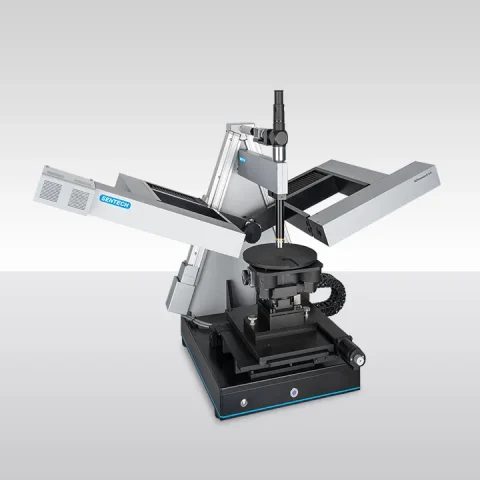
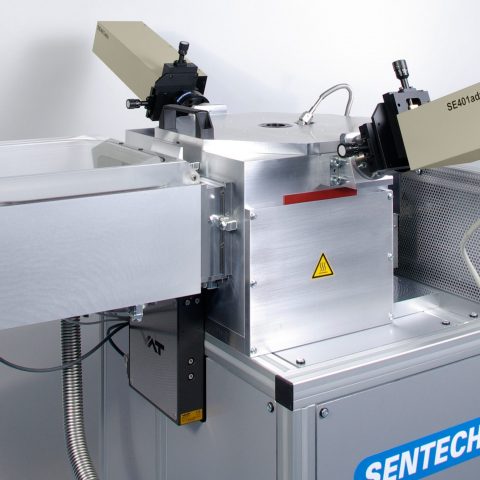
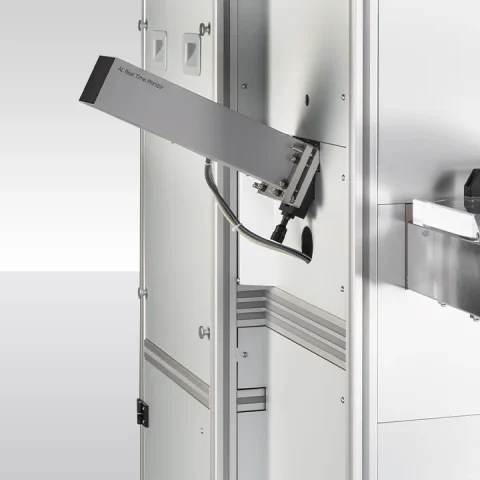
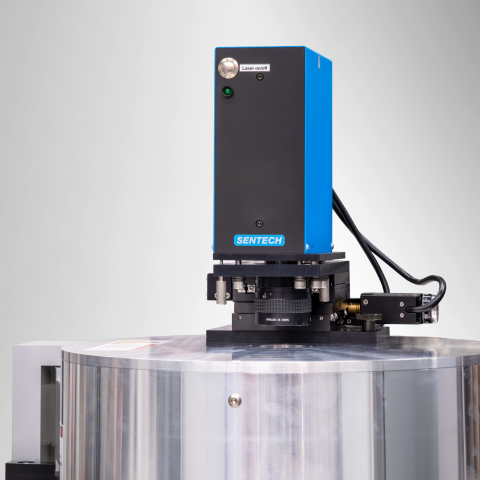
The SENTECH spectroscopic ellipsometry range, SENresearch 4.0 in-situ spectroscopic ellipsometer, SE401adv in-situ laser ellipsometer, AL Real Time Monitor and the SLI laser-based interferometric EPD are trusted worldwide for their precision, flexibility, and ease of use. Designed for both cutting-edge research and small-scale production, SENTECH systems deliver accurate thin film measurements with intuitive software and robust hardware. Their modular design allows seamless adaptation to diverse applications, from semiconductors to nanomaterials. SENTECH is the reliable choice for high-quality, reproducible results.